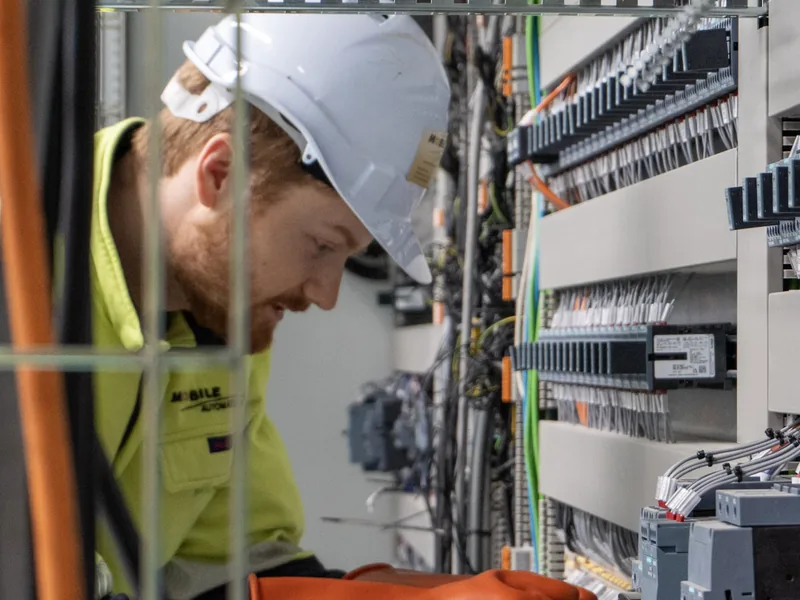
Mobile Automation supports industrial customers with practical electrical maintenance across production equipment, switchboards, control cabinets, field wiring and site electrical infrastructure.
Looking for something ongoing rather than job-by-job? See maintenance agreements — planned maintenance, the same crew who know your site, and priority support.
Industrial maintenance is about reducing avoidable downtime, identifying issues before they become breakdowns and keeping electrical infrastructure in a safe and serviceable condition. Mobile Automation can support planned maintenance, reactive maintenance, shutdown maintenance and follow-up rectification works for manufacturing, process and industrial sites.
Maintenance work can be planned around production requirements, access limitations, site inductions, shutdown windows and customer maintenance schedules.
The problems maintenance is meant to solve
Most manufacturers do not go looking for a maintenance program. They go looking after the third unplanned stoppage in a quarter, or the week an auditor asks for records nobody can produce.
- Stoppages that were predictable — the loose termination, the unbalanced phase, the bearing on its way out. These announce themselves long before they take a line down, and a scheduled inspection is how they get found.
- Compliance evidence nobody can find — the work was done, the records were never collated, and reconstructing two years of maintenance history under audit pressure is expensive.
- A different contractor every time — re-explaining the plant, re-finding the switchboard, re-learning which machine is temperamental. You pay for that relearning on every single visit.
What electrical maintenance covers
Mobile Automation can assist with a range of industrial electrical maintenance tasks, subject to scope, site conditions, safety requirements, licensing, insurance and agreed customer arrangements.
- Scheduled industrial electrical maintenance visits
- Switchboard and control cabinet inspections
- Electrical checks on production equipment and machinery
- Field device, sensor, motor and control circuit checks
- Rectification of minor electrical defects
- Maintenance shutdown support
- Follow-up works after breakdowns or fault-finding attendances
- Testing, inspection and practical maintenance reporting
- Recommendations for reliability and safety improvements
- Electrical support for customer maintenance teams
Planned and reactive maintenance
Mobile Automation can support both planned and reactive maintenance requirements. Planned maintenance may include inspections, testing, defect rectification, cabinet checks, equipment checks and works completed during shutdown windows. Reactive maintenance may involve responding to a known issue, recurring fault, failed component or production concern.
Where issues are identified, Mobile Automation can help prioritise practical next steps, including whether the item can be rectified immediately, planned into a shutdown, quoted as follow-up work or monitored as part of a broader maintenance plan.
What maintenance can help identify
Regular electrical maintenance can help identify electrical issues before they create downtime, safety risks or production problems.
- Loose, damaged or deteriorated wiring and terminations
- Control cabinet issues such as heat, dust, labelling or access problems
- Defective field devices, sensors, switches or control components
- Switchboard wear, overheating, nuisance tripping or access concerns
- Recurring machine faults or reliability issues
- Outdated, difficult-to-maintain or poorly documented electrical equipment
- Minor defects that should be rectified before they become breakdowns
Ongoing maintenance agreements
Most of this work is better done as a standing arrangement than job by job. What that gives you:
- Planned maintenance rather than waiting for a failure — scheduled around your production and shutdown windows, not ours.
- The same crew who know your site — this is the part that compounds. A crew that has been into your plant a dozen times does not need to be told where the isolator is.
- One team across electrical, automation, robotics and mechanical — under a single electrical licence. There is no gap between the automation scope and the electrical scope, because they are the same company.
- Priority support for customers on an agreement — agreement holders come first when the phone runs hot.
- Electrical breakdown support available — see how a breakdown call is handled.
- Compliance documentation, asset registers and reporting — collected as the work happens rather than reconstructed later.
Start with a site assessment
An agreement should not be written from a price list. It should be written from your plant. So the first step is a site assessment, and there is no obligation attached to it.
An assessment involves:
- A walk of the site with an electrician and, where the plant warrants it, an automation engineer
- A review of your switchboards, distribution and critical assets
- An honest assessment of what actually causes stoppages on your plant — which is rarely what the last contractor said it was
- A written recommendation tailored to that site, covering what is worth maintaining on a schedule and what is not
If the recommendation is that you do not need an agreement, we will say so. Some plants are better served by a scheduled thermal scan once a year and a phone number for when something stops.
How an agreement is shaped around your site
There is no standard agreement, because there is no standard plant. What an arrangement looks like depends on:
- How many shifts you run, and when the plant is actually available to work on
- Asset count and asset age — a 1990s switchboard and a machine bought last year need different attention
- What a stoppage genuinely costs you per hour, which determines how much preventative work is worth doing
- What you already have in place, and who currently does it
Scope, frequency and commercial terms are set with you once the assessment is done. That is not a hedge — it is the only honest way to price this work.
Suitable for
This service is suited to industrial customers that need ongoing or occasional electrical maintenance support, including:
- Manufacturing and production facilities
- Food and beverage production sites
- Process and packaging environments
- Warehouses and industrial premises
- Machinery suppliers and OEM-supported equipment
- Recycling, quarrying and heavy industrial sites
- Maintenance teams needing additional electrical support
- Sites preparing for shutdowns, audits or reliability improvements
Already a customer?
If we already attend your site for breakdowns, most of the assessment work is done — we know the plant. It is usually a conversation rather than a survey. Get in touch and we will pick it up from what we already have on file.
Local service area
Mobile Automation supports electrical maintenance requirements across Melbourne, South East Melbourne, the eastern suburbs and broader Victoria. Common service areas include Dandenong, Dandenong South, Moorabbin, Keysborough, Clayton, Springvale, Braeside, Carrum Downs, Hallam, Scoresby, Rowville, Bayswater, Lilydale, the Yarra Valley and surrounding industrial areas.
Frequently asked questions
Can Mobile Automation provide scheduled maintenance visits?
Yes. Scheduled maintenance can be arranged for approved customers based on site requirements, equipment priority, access conditions, safety requirements and agreed scope.
What does a site assessment involve?
A walk of the site, a review of your switchboards, distribution and critical assets, and an assessment of what actually causes stoppages on that plant. You receive a written recommendation tailored to the site.
Do I have to commit to anything to get an assessment?
No. The assessment is a standalone piece of work and produces a written recommendation you are free to act on, shelve or take to someone else.
Can an agreement cover automation and mechanical work as well as electrical?
Yes. Mobile Automation holds the electrical licence and delivers automation, robotics and mechanical work with the same team, so an arrangement can span all four disciplines without subcontracting.
Is breakdown support available to agreement holders?
Yes. Electrical breakdown support is available for approved customers, and those on a maintenance agreement receive priority support.
Can maintenance work be completed during shutdowns?
Yes. Maintenance can be planned around shutdown windows where equipment access, isolation and production downtime are easier to manage.
What documentation comes with an agreement?
Asset registers, maintenance records, defect observations and compliance documentation, collected as the work happens so the history exists when an auditor or insurer asks for it.
How is an agreement priced?
Pricing is set with you after the site assessment, based on shifts, asset count and scope. There is no standard rate card because there is no standard plant.
Does Mobile Automation maintain domestic or residential properties?
No. Mobile Automation works with industrial and commercial sites only.
Have more questions? Get in touch with our team and we'll be happy to help.