
The failures you can see before they happen
Most electrical failures announce themselves as heat long before they trip anything. A loose termination, an unbalanced phase, an undersized cable, a motor bearing on its way out — all of them run hot for weeks or months first.
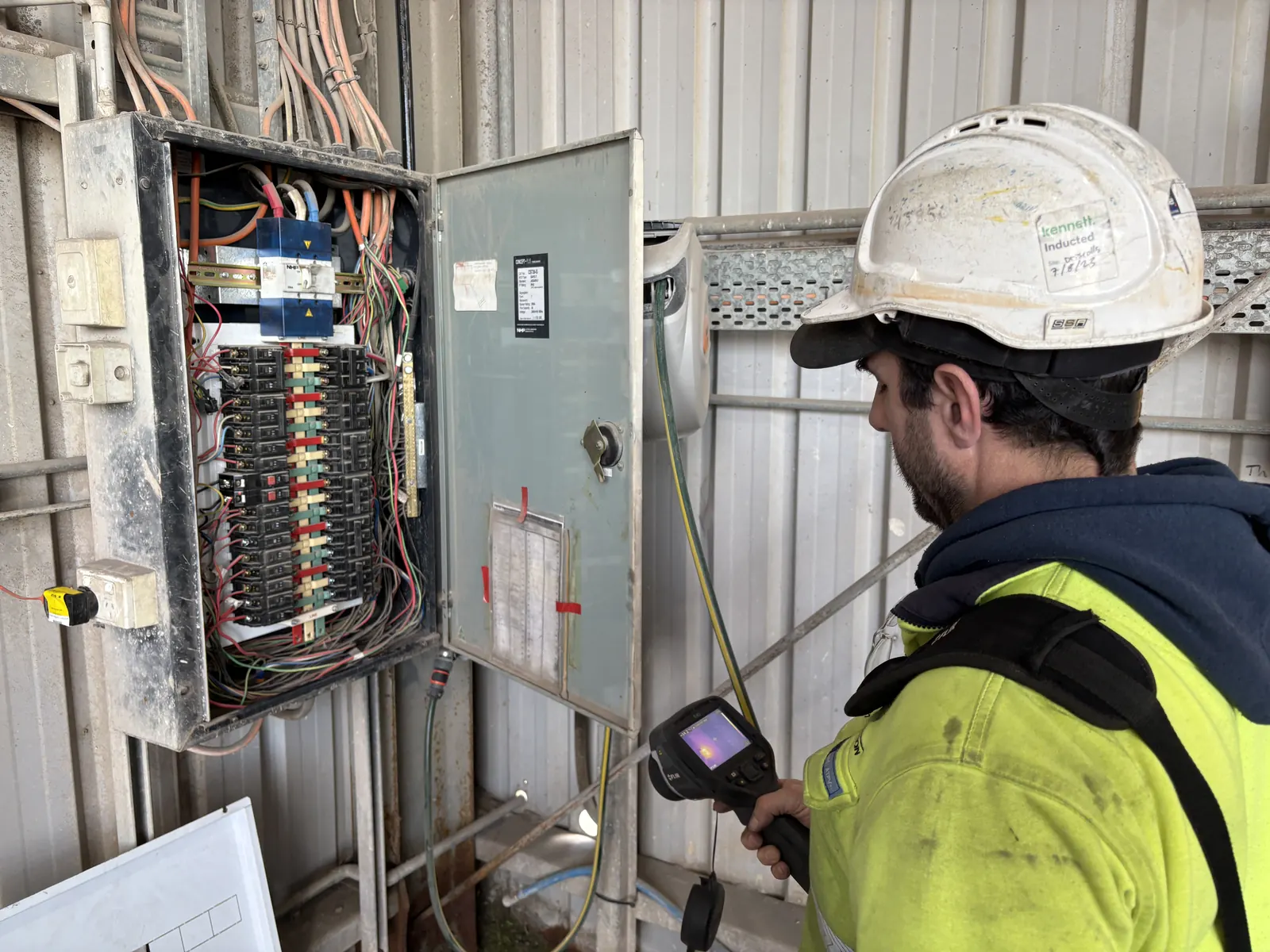
Thermal imaging finds them without taking anything offline. We scan switchboards, distribution boards, MCCs, motors, drives, cable runs and mechanical drive assemblies under normal production load, because that's the only condition where the fault actually shows itself. You get a report with images, temperature deltas, a severity rating and a plain-English recommendation for each finding.
Then — and this is the part a specialist scanning company can't do — we can fix what we found. Same team, same visit if it's urgent.
What we scan
- Switchboards, distribution boards and MCCs — terminations, busbars, breakers, contactors, phase balance
- Motors and drives — bearing temperature, cooling, VSD and soft-starter cabinets
- Cable runs and joints — including sub-mains and machine supplies
- Machinery and mechanical assemblies — gearboxes, couplings, conveyor drives, pumps
- Process equipment — where surface temperature indicates a process or insulation problem
What you get
Every scan produces a report you can act on and file:
- Thermal and matching visual image for each finding
- Measured temperature rise above reference, with load conditions recorded
- Severity classification and a recommended timeframe for action
- Plain-English cause and recommended repair
- Asset register, so year-on-year comparisons actually mean something
Reports are written to be usable by a maintenance planner, an insurer and an auditor — not just an electrician.
Scanning is carried out by qualified thermographers using calibrated equipment, on your site and under normal production load.
Scanning that comes with a repair crew
Most thermal imaging in Victoria is sold by scanning specialists who hand you a PDF and leave. That's fine until you have twelve findings and nobody to close them out.
We're a Registered Electrical Contractor with our own electricians, fitters and automation engineers. So a thermal survey with us can end with the work actually done: terminations remade, breakers replaced, boards upgraded, motors changed out, and the fix verified with a follow-up scan. If a finding turns out to be mechanical rather than electrical, our fitters handle it — no second contractor, no second mobilisation.
How often
- Switchboards and distribution systems — every 6 to 12 months
- Critical or high-load equipment — quarterly
- Before and after a shutdown — to verify workmanship and catch what the shutdown disturbed
- After a load change or plant expansion — new load reveals old weaknesses
Most sites run thermal imaging as part of a scheduled preventative maintenance programme. We can build it into an annual plan alongside the rest of your compliance testing, so it's one visit, one report cycle, one invoice.
Frequently asked questions
Does the plant need to be shut down?
No — the opposite. Thermal scanning has to be done under load to be meaningful, so we scan during normal production. We do need safe access to live switchboard interiors, which means covers off by a licensed person; our electricians do that as part of the job.
How quickly do we get the report?
Within five business days for a standard site survey, and immediately by phone for anything we classify as urgent. If we find something dangerous, you'll know before we leave site.
Can you fix what you find?
Yes. We're a Registered Electrical Contractor with mechanical trades in the same business. Most customers have us quote the remediation alongside the report and close out the findings in a single planned visit.
How often should switchboards be scanned?
Common practice is every 6 to 12 months for switchboards and distribution systems, and quarterly for critical or high-load equipment. Many sites also scan before and after a shutdown to verify workmanship. Your insurer may specify a frequency — worth checking your policy.
Do you scan mechanical equipment as well as electrical?
Yes — gearboxes, bearings, couplings, conveyor drives and pumps all show developing faults thermally. Because we have a mechanical services team, we can interpret and act on those findings rather than just flagging them.
Have more questions? Get in touch with our team and we'll be happy to help.