Mobile Automation supplies, integrates and supports Universal Robots cobots across Victoria — the arm, the cell around it, the programming, and the spares and service afterwards.
A cobot arrives in a box. What it does not arrive with is the gripper that suits your product, the frame it mounts to, the guarding your risk assessment turns out to require, the conveyor feeding it, the PLC handshake with the machine it tends, or the program that makes it repeatable at 3am with a casual operator watching.
That gap is where most robot projects stall. We close it in-house — electrical, mechanical, controls and safety from the same team — so one contractor is accountable for the cell working, rather than four pointing at each other.
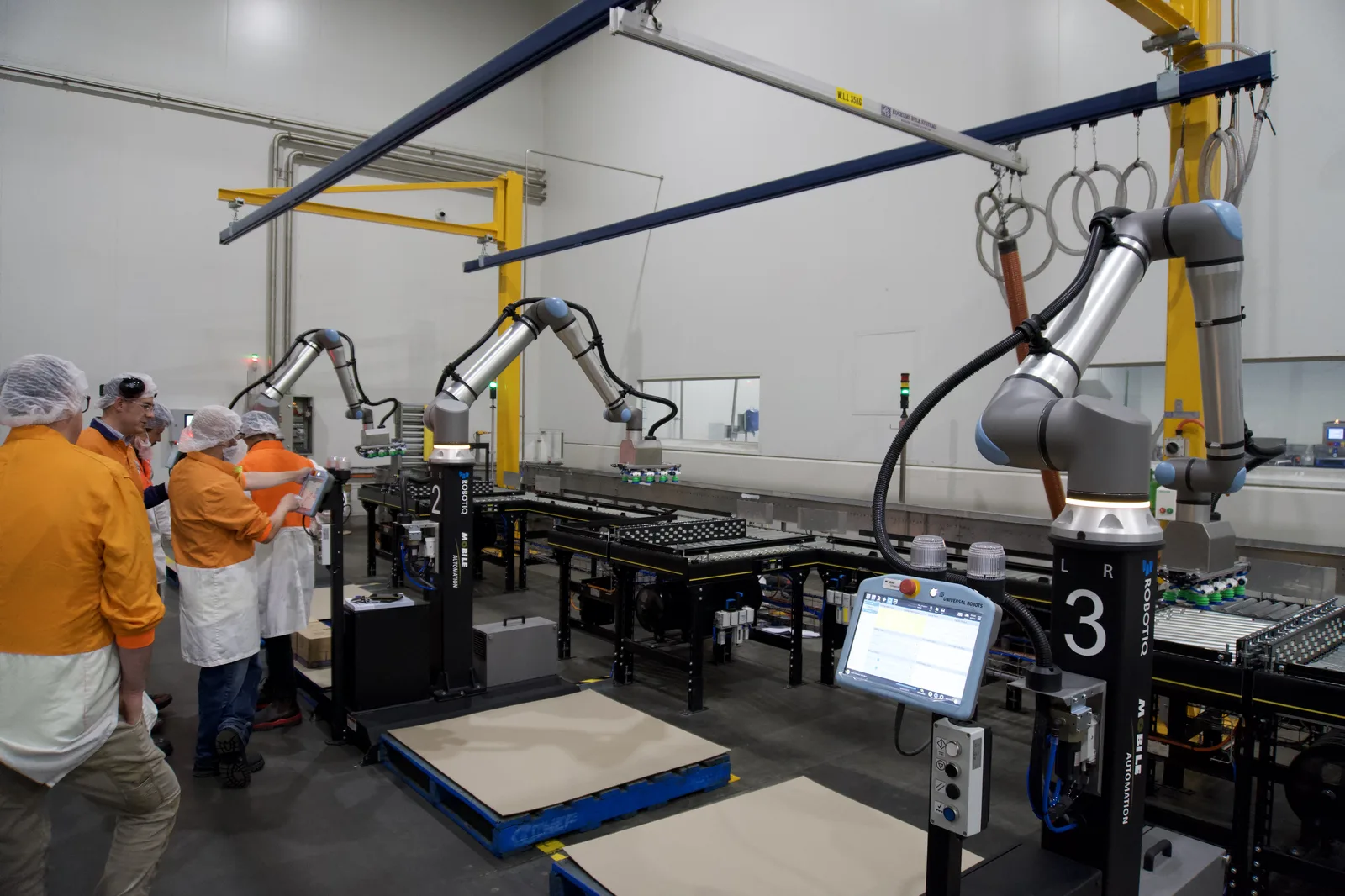
The Universal Robots range
UR builds two families. The e-Series covers most industrial applications; the UR20 and UR30 extend into heavier payloads and longer reach, which is what most palletising jobs actually need.
- UR3e — 3 kg payload, 500 mm reach. Benchtop work: small part assembly, screwdriving, lab and electronics handling.
- UR5e — 5 kg, 850 mm. The general-purpose workhorse — light machine tending, pick and place, inspection, packing.
- UR10e — 12.5 kg, 1300 mm. Heavier machine tending, carton handling, light palletising.
- UR16e — 16 kg, 900 mm. High payload in a compact footprint, for dense cells and multi-part tooling.
- UR20 — 20 kg, 1750 mm. Built for palletising: full pallet height without a lift column.
- UR30 — 30 kg, 1300 mm. Heavy payload for machine tending, bag handling and high-mass parts.
If you are weighing a cobot against a six-axis industrial robot, the deciding factors are usually cycle time and payload rather than price. We build both, so the recommendation is not tied to what we happen to stock — see industrial robots for where a conventional arm is the better answer.
What we build with them
- Palletising and depalletising — cartons, bags and crates, with pattern software and pallet handling
- Machine tending — CNC, injection moulding, presses and test rigs, including the machine interface
- Pick, place and packing — often with machine vision for unfixtured parts
- Cobot welding — MIG and TIG cells for short runs and high-mix fabrication
- Screwdriving, dispensing, sanding, inspection and quality sampling
Spare parts and service
We hold and order UR spares from Montrose — joints, control boxes, teach pendants, cables, grippers and consumables. Support is not limited to cells we installed: if you have UR robots from another supplier, we can take on programming, repairs, spares and breakdown response.
That matters more than it sounds. A cobot that stops on a Friday afternoon, with nobody local who can diagnose it, is an expensive paperweight until Monday.
Safety and compliance
Collaborative is a property of the application, not of the robot. The same arm can be genuinely safe to work beside with one tool and genuinely dangerous with another. Every cell we build gets a risk assessment, and where the application needs it, power and force limiting is verified by measurement and the safety functions validated to AS/NZS 4024 and ISO 13849.
We would rather tell you a cell needs guarding than hand over something that passes on the brochure and not on your floor.
Why take the robot and the integration together
- One accountable contractor — electrical, mechanical, controls, safety and programming from the same team, on one job number
- Sized on the application — we quote the model the job needs, and say so when a cobot is the wrong answer entirely
- Local spares and service — from Montrose, across Melbourne and regional Victoria
- Operator training and documentation — your people run it, not us
- Proven off-site first — cells built and tested in our workshop before they reach your floor
Frequently asked questions
Do you sell Universal Robots, or just integrate them?
Both. We supply UR cobots and we build the cell around them — tooling, guarding, safety, electrical, programming and commissioning. Buying the arm on its own rarely solves the problem; what makes it work is everything attached to it.
Which UR model do we need?
It depends on payload, reach and cycle time, and the honest answer usually only comes after we look at the application. A UR5e handles most light pick-and-place; palletising cartons generally wants a UR20 or UR30 for the reach and payload. We would rather size it correctly than sell you a bigger arm than the job needs.
Can you supply spare parts and consumables?
Yes. Joints, control boxes, teach pendants, cables, grippers and consumables, held or ordered from Montrose. If you already run UR robots installed by someone else, we can still supply parts and support them.
Do we need guarding for a collaborative robot?
Sometimes. Collaborative is a property of the application, not the robot. A cobot moving a blunt-edged carton at low speed may need none; the same arm holding a knife, a hot part or running at speed will. It is settled by a risk assessment, not by the brand on the arm.
Can you support UR robots we bought elsewhere?
Yes. We take on programming, repairs, spares, safety validation and breakdown support for UR cobots regardless of who supplied them originally.
What does a complete cobot cell cost?
For a straightforward palletising or machine-tending cell, typically $80k to $250k installed depending on tooling, conveyors, guarding and integration. The robot itself is usually well under half of it. We quote fixed after a site visit.
Have more questions? Get in touch with our team and we'll be happy to help.